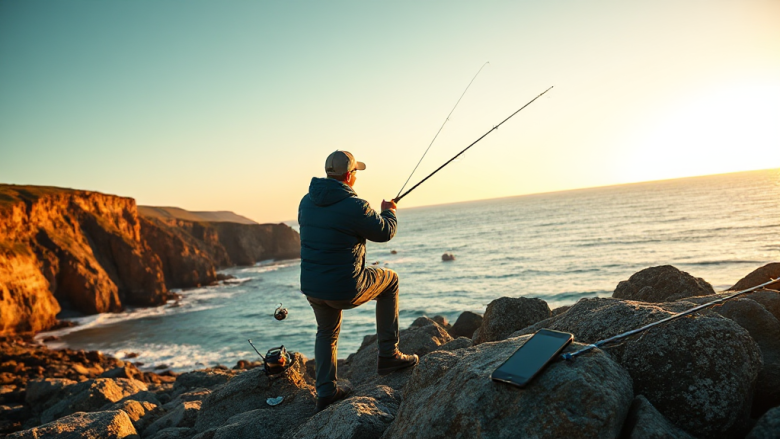
Online Licence Innovation: Why Fishing in Portugal No Longer Needs a Queue
Travel admin is supposed to be the boring part you get through quickly before the good part begins. Yet for years, one small task has stubbornly resisted that logic along the Portuguese coast: sorting out the paperwork before you can legally cast a line into the Atlantic. Anyone who has planned a trip around fishing in portugal knows the feeling — you have the rods packed, the tides checked, the marks mapped out, and then you hit a bureaucratic wall that seems designed for a different century. The good news is that the wall is coming down, and online application services are the reason.
This comparison looks at the DGRM recreational sea fishing licence through a single lens: convenience. How do the traditional routes stack up against the online services now available, feature by feature? And if you simply want to be legal on the rocks by tomorrow morning, which route actually gets you there?
The Traditional Route: What Applying Used to Involve
To understand why the online option matters, it helps to be honest about what the old process asked of you. The DGRM licence itself is a straightforward concept — a recreational sea fishing permit for mainland Portugal — but the path to holding one was rarely described as straightforward by visiting anglers.
The classic approach meant dealing with a government portal or a physical office. That typically brought a cluster of small frictions that added up:
Language and interface barriers. Government portals are built first for residents who speak the language and know the system. For a tourist arriving from abroad, every field is a small puzzle, and a mistyped detail can mean starting over.
The NIF requirement. Many traditional routes assume you hold a Portuguese tax number. If you are on holiday for a week, you almost certainly do not — and obtaining one is a project in itself, not a checkbox.
Office hours and geography. Physical offices keep the hours that suit offices, not the hours that suit people who have just landed, collected a hire car, and want to fish the evening tide. If your arrival day is a Sunday or a public holiday, the queue simply is not there to join.
Uncertainty about what you actually need. Recreational sea fishing from shore, boat fishing, and other categories can carry different requirements. Without local knowledge, it is easy to apply for the wrong thing or assume you need nothing at all.
None of this is unusual. Plenty of countries make visitors jump through comparable hoops. The point is not that the traditional system is broken — it is that it was designed around a world where you had days to spare and a local address to lean on.
What the Online Application Model Changes
Online licence services exist to compress that entire experience into a few minutes on your phone. The model behind them is simple: you are not interacting with the government portal directly, and you are not managing the paperwork yourself. You are using a service that handles the application on your behalf, in a format built for people who are not residents and not fluent in the local bureaucracy.
The most visible change is time. An application through a dedicated online service takes roughly three minutes — the kind of task you can finish in a car park overlooking the sea, or at the airport gate, or the night before while checking tomorrow’s swell forecast.
Just as important is what disappears. There is no NIF requirement, so a tourist without a Portuguese tax number is not locked out. There is no need to navigate a government portal whose logic assumes familiarity. And there is no dependence on office opening hours, because the application is not tied to a counter or a queue.
This is where the innovation angle becomes concrete rather than abstract. The licence itself is the same legal instrument. What has changed is the interface between the angler and the requirement — and that interface is now a modern web form instead of a window with a number above it.
For anyone who has previously abandoned a fishing plan because the admin felt heavier than the reward, this is the practical shift worth understanding. A fishing license should be a five-minute errand, not a half-day detour, and the online model treats it that way.
Feature-by-Feature: Traditional vs Online
Comparing the two routes side by side makes the trade-offs clear. Here is how they stack up across the factors that actually affect a fishing trip.
Time to complete. Traditional routes can take anything from a lengthy portal session to a trip into town, with waiting time built in. Online applications run to about three minutes end to end. For a short holiday, that difference is the whole ballgame.
Documentation requirements. The traditional path often assumes a NIF and local familiarity. The online path is designed for visitors, which means it does not hinge on a Portuguese tax number. That single change opens the door to a large group of anglers who were previously put off entirely.
Payment options. Older routes frequently involve payment methods that are awkward from abroad — bank references, local transfers, or card systems that may or may not cooperate with a foreign card. Online services accept card, Apple Pay, and Google Pay, which means the payment step is the one you already use every day.
Access and timing. Offices keep office hours. Online applications do not. If your trip starts at midnight or your only free moment is a Sunday morning, the online route is available and the traditional one is not.
Clarity of the requirement. A government portal tells you what the state needs. A service built around recreational sea anglers tells you what you need as an angler — the category that applies, the coverage for mainland Portugal, and the fact that you can now finish the task without leaving your accommodation.
Failure modes. With the traditional route, a mistake often means restarting or seeking help you cannot easily find. With a purpose-built online service, the form is structured around the visitor’s situation from the first field, which reduces the chance of a dead end.
Read together, the pattern is consistent: the online model wins on every dimension that matters to a travelling angler, and it does so without changing the underlying legal requirement. You still need the licence. You just no longer need a free morning to get it.
Payment, Speed, and the Practical Recommendation
If you are the kind of angler who books flights first and sorts details later, the recommendation is straightforward: use the online route, and do it before you travel rather than after you arrive. The reasons are practical rather than ideological.
First, payment. Card, Apple Pay, and Google Pay cover virtually every traveller’s situation. You are not hunting for a local bank, converting a transfer, or hoping a foreign card is accepted by an unfamiliar system. The transaction is the same one you complete for a hotel or a train ticket.
Second, speed. Three minutes is short enough to fit into almost any itinerary — a taxi ride, a coffee, the wait for baggage. That means you can arrive with the admin already done and spend your first evening on the water instead of on a form.
Third, certainty. Applying before you travel removes the risk that a public holiday, a closed office, or a confusing portal field derails your first day. It also gives you a clear answer about what you need before you have invested in gear hire, boat time, or a guide.
There is also a broader point about how portugal fishing is experienced by visitors. The country’s coastline is one of the great draws for European sea anglers — cliffs, Atlantic swell, long sandy beaches, and a genuine variety of species and conditions. The last thing that experience should be gated behind is a queue. When the permit process becomes a three-minute task on a phone, the balance shifts back where it belongs: toward the fishing itself.
For residents, the traditional route may still feel familiar and adequate. For tourists, short-stay visitors, and anyone without a NIF, the online service is not just more convenient — it is the difference between fishing legally and not fishing at all. That is the strongest argument for it, and it is why the innovation matters beyond mere tidiness.
What This Means for Your Next Trip
The comparison ultimately comes down to a simple question: do you want your licence sorted in three minutes from your phone, or do you want to spend part of your holiday solving an administrative puzzle in a language you may not speak? Framed that way, the choice is not close.
Online application services have not changed the rules of recreational sea fishing in mainland Portugal. They have changed the experience of complying with them, and in doing so they have removed the most common reason visiting anglers gave for skipping the licence altogether. The requirement stays; the friction goes.
So plan the trip around the tides, the marks, and the species you want to target. Pack the rods, check the weather, and sort the licence while you are still at home with a reliable connection. The queue was never the point of fishing in Portugal — and now, thankfully, it no longer has to be part of it.